 By Ethan Brooks
Updated November 2026
A black solar pool heater uses dark, heat-absorbing panels to warm pool water as it passes through the collector, usually without any fuel cost once installed. The right choice depends on your pool size, the flow your pump can deliver, your roof or ground space, and how much wind and freezing weather you expect. The picks below are compared on those criteria, using manufacturer specifications and patterns in owner feedback rather than hands-on testing.
Our top picks at a glance
- 1
 TOP CHOICEBest overallFAFCO Original 4 x 20 Feet Solar Bear Solar Pool HeaterView on Amazon
- 2
 TOP CHOICEBest for long service lifeUniversal Solar Pool Heater Panel Replacement (4' x 12')View on Amazon
- 3
 TOP CHOICEBest for seasonal, low-effort heatingGoFloats V2 Inflatable Solar Pool Heaters 3 PackView on Amazon
- 4
 Best for Intex above-ground pools28685E Solar Pool Water Heater MatView on Amazon
- 5
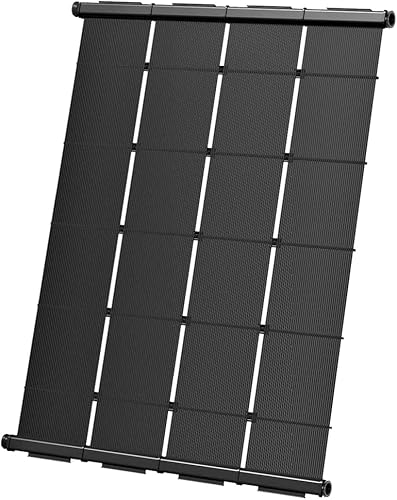 Best for windy or cold sitesIndustrial Grade Solar Pool Heater Panel (4' x 10.5')View on Amazon
Our Top Picks
Quick Comparison
| Product | Best for | Key feature |
|---|---|---|
| FAFCO Original 4 x 20 Feet Solar Bear | Overall fit for standard pools | Connected tube design |
| Universal Solar Pool Heater Panel Replacement | Long service life | 15–20 year rated life |
| GoFloats V2 Inflatable Solar Pool Heaters | Seasonal, low-effort heating | Inflatable 3-pack |
| 28685E Solar Pool Water Heater Mat | Intex above-ground pools | Works with 2,000 GPH pumps |
| Industrial Grade Solar Pool Heater Panel | Windy or cold sites | Strapless high-wind mounting |
FAFCO Original 4 x 20 Feet Solar Bear Solar Pool Heater
FAFCO Original 4 x 20 Feet Solar Bear Solar Pool Heater for Above-Ground Pools Universal with Connected Tube Design & Starter Kit
Best for: Overall fit for standard above-ground and universal pool setups.
This is a full-length panel system for owners who want a complete, universal kit with a starter set. Manufacturers specify a connected tube design that suits multi-panel arrays on flat ground or a roof.
Pros
- Universal fit with a starter kit included
- Connected tube design simplifies array layout
Cons
- Requires enough open space for a 20-foot run
Universal Solar Pool Heater Panel Replacement (4′ x 12′)
Highest Performing Design – Universal Solar Pool Heater Panel Replacement – 15-20 Year Life Expectancy (4' X 12' / 2" I.D. Header)
Best for: Long service life and replacing worn panels.
This listing is aimed at owners who want a durable replacement panel with a 2-inch header. Listings cite a 15–20 year life expectancy, which is most relevant to owners planning a long-term installation.
Pros
- Manufacturer cites a 15–20 year life expectancy
- Standard 2-inch I.D. header for common plumbing
Cons
- Header size must match your existing manifold
GoFloats V2 Inflatable Solar Pool Heaters 3 Pack
GoFloats V2 Inflatable Solar Pool Heaters for Affordable Pool Heating and Insulation – 3 Pack
Best for: Seasonal, low-effort heating and added insulation.
Inflatable units suit owners who want to float a heater on the surface without roof mounting. Owners often use them for shoulder-season warming and cover-style insulation. We also found 7 Best Pool Solar Heater Bypass Kits for Every Setup (2026) useful on this point.
Pros
- No roof or ground mounting required
- Three-pack covers larger surface area
Cons
- Heating output is modest compared with fixed panels
28685E Solar Pool Water Heater Mat
28685E – Energy-Efficient Heating – Designed to work with INTEX Filter Pumps up to 2,000 GPH, 47.25" x 47.25" INTEX Solar Pool Water Heater Mat for Above Ground Swimming Pools
Best for: Intex above-ground pools with a standard filter pump.
This mat is sized for 47.25-inch square footprints and is specified for use with Intex filter pumps up to 2,000 GPH. It fits owners who want a simple add-on rather than a plumbed panel array.
Pros
- Specified for pumps up to 2,000 GPH
- Simple mat layout with no plumbing
Cons
- Limited to Intex-compatible setups
Industrial Grade Solar Pool Heater Panel (4′ x 10.5′)
Industrial Grade Solar Pool Heater Panel – Superior High-Wind Strapless Mounting System & Maximum Freeze Resistance (4' X 10.5')
Best for: Windy or cold sites where mounting and freeze resistance matter.
Listings emphasize a strapless high-wind mounting system and freeze resistance, which suits exposed roofs or open yards in colder climates.
Pros
- Strapless mounting designed for high-wind sites
- Marketed with maximum freeze resistance
Cons
- Heavier mounting hardware to plan for
Buying Guide
Match panel area to pool volume
As a working rule, panel area should be sized against your pool volume and the heat gain you need, not just the footprint of your yard. Check the manufacturer’s sizing chart before you buy, and remember that a larger array only helps if your pump can move the water through it.
Check pump flow and head
Solar panels lose heat quickly if flow is too low, and too much head pressure can strain the pump. Confirm your pump’s GPH rating at the head height of your roof or mounting site.
Plan for wind and freezing
Exposed roofs need strong mounting, and freeze-prone climates need panels rated for it. Look for listed freeze resistance and a mounting system that suits your wind exposure.
Consider your mounting space
Ground-mounted and roof-mounted arrays have different layout and plumbing needs. Measure before buying so panel lengths and header sizes fit the space you have.
Good picks for this: Industrial Grade Solar Pool Heater Panel and FAFCO Original 4 x 20 Feet Solar Bear
FAQ
How do I know how big a black solar pool heater I need?
Panel size should be matched to your pool’s volume and how warm you want the water to get. Smaller above-ground pools can often be heated with a single compact panel or an inflatable mat, while larger in-ground pools usually need a bigger collector array. When in doubt, compare the panel area to your pool’s gallons and check the manufacturer’s sizing guidance.
Will my pump be able to run a solar heater?
Your pump needs enough flow and pressure to push water through the panels without overloading the system. Check the rated flow of your pump and the head pressure the panels require before you buy. If your pump is underpowered, a larger pump or a different panel size may be a better fit.
Do black solar pool heaters work in cold weather?
They can extend your swimming season, but output drops on cloudy or cold days and they will not heat a pool to hot-tub temperatures. Freeze protection matters in colder climates, so look for designs that drain or handle freezing conditions well. Pairing the heater with a pool cover can also help retain the warmth you collect.
Can I install a solar pool heater myself?
Many panels are designed for do-it-yourself installation, especially the inflatable and lightweight models that lay on the ground. Rooftop or ground-mounted systems take more planning around mounting, plumbing, and wind loads. Follow the manufacturer’s instructions and local code requirements, and consider a professional if the setup is complex.
How long do black solar pool heater panels last?
Lifespan depends on the panel material, UV exposure, climate, and how well the system is maintained. Some panels are rated for many years of service, while inflatable mats may need replacing sooner. Checking for cracks, leaks, and UV damage each season will help you get the most out of your investment.
Do I need a timer or controller with a solar pool heater?
A basic solar heater works automatically as long as the pump runs during sunny hours, so a separate controller is not always required. A timer or valve can help you run the pump at the most effective times and protect the system. Some owners add a temperature sensor for more precise control.
Conclusion
If you want a proven, widely used option for a standard setup, the top-rated FAFCO-style panels are a strong starting point, especially for in-ground pools with adequate roof or ground space. For a lower-cost, easy-to-install choice on an above-ground pool, the inflatable mats and the INTEX-compatible mat are practical picks, while buyers in windy or freezing regions should look closely at the high-wind and freeze-resistant designs.
Match the panel size to your pool volume, confirm your pump can handle the flow, and choose the mounting method that suits your space. Those three checks will narrow the list quickly and help you pick the option that fits your pool best.
Related reading
- 7 Best Black Plastic Solar Pool Heater Options for 2026
- 4 Best DIY Solar Pool Heater Black Hose Options for 2026
- Xtremepowerus Solar Pool Heater: Setup, Sizing and Common Mistakes
About Ethan Brooks
Ethan Brooks is part of our editorial team and reviews and edits our solar water systems guides, checking product details against manufacturer specifications and owner feedback.