By Ethan Brooks
Updated November 2026
To choose the right size solar pump for a water feature, start with two numbers: the flow rate you want at the top of the display and the total head height the pump must lift water against. Match those to the pump’s performance curve, then size the solar panel so it delivers enough watts under real sunlight. Most small garden fountains run well on a pump rated for roughly 100 to 300 gallons per hour at low head.
Why flow rate and head height decide the pump size
A pump’s flow rate is the volume of water it moves per hour, usually listed in gallons per hour (GPH) or liters per hour (LPH). Head height is the vertical distance from the water surface in the sump or pond up to the highest outlet, plus any friction loss from pipe and fittings. The two work against each other: the higher the head, the less flow you get.
Shopping for one? See our guide: 5 Best Solar Water Pumps for Small Fountain Picks Compared (2026).
Manufacturers publish a performance chart showing flow at several head heights. Read that chart, not the maximum GPH on the box. A pump rated at 300 GPH at zero head may deliver well under 100 GPH at 3 feet of lift.
Factors that set the right size
- Total head: Measure from the water line to the nozzle, then add roughly 1 foot for every 10 feet of tubing as friction loss. Use the total for the chart lookup.
- Desired spray effect: A gentle bubbler needs far less flow than a tiered fountain. A tall jet throws water higher only if the pump has enough pressure at your head height.
- Panel wattage: Solar pumps are typically rated against panel wattage. Owners often report that a panel of 20 to 50 watts runs many small submersible fountain pumps in good sun, but the pump only runs at full output during peak hours.
- Sun exposure: Partial shade or a panel facing away from the sun can cut output sharply. Plan for roughly 4 to 6 hours of direct sun for a steady display.
How to size your system
- Measure the water surface to the highest nozzle in feet.
- Add friction allowance for your tubing length and fittings.
- Decide on the flow you want at that total head, using the manufacturer’s chart.
- Choose a pump whose chart shows at least that flow at your total head, with a little margin.
- Check that the solar panel’s rated wattage matches the pump’s stated requirement, and confirm whether the pump includes a battery or runs only in daylight.
- Place the panel where it gets unobstructed sun during the hours you want the fountain running.
What we’d use
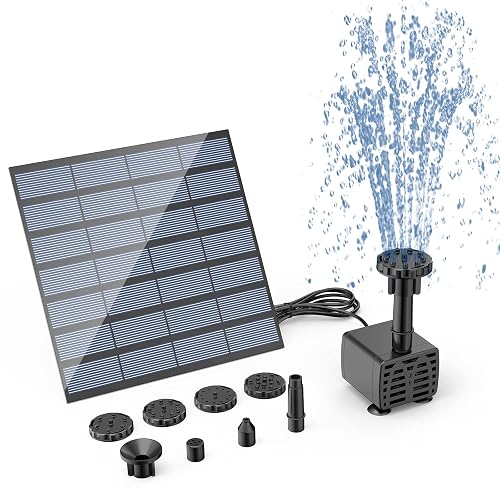
For a small garden or patio fountain with a low head, a compact submersible unit paired with its matched panel is the simplest route. Look for a model that lists flow at several heights: Sunnytech Solar Fountain Pump Kit. View on Amazon
For a taller display or a pond with a longer run, look for a higher-head submersible model with a panel rated for it: Alpha Sun Solar Water Pump Kit. View on Amazon
For a broader comparison of fountain-specific models, see Solar Powered Water Pump for Small Fountain: 7 Best Picks Compared (2026). If you are wiring a separate panel to an existing pump, Solar Panels for Fountain Pump: How to Size, Wire and Set One Up covers the electrical side.
FAQ
Can I use a bigger pump than I need?
You can, but an oversized pump may throw water too high, splash out of the basin, or waste energy. Pick one whose flow at your head height matches the display you want.
How do I know if my panel is big enough?
Compare the panel’s rated wattage with the pump’s stated input requirement. Also consider sun hours at your location. Consult the manufacturer’s sizing guide or a qualified installer if the numbers are close.
Will the pump work on cloudy days?
Output drops on overcast days, so the pump may run slowly or stop. A battery-backed kit keeps water moving into the evening, but check the specs before buying.
Related reading
Ready to choose one?
About Ethan Brooks
Ethan Brooks is part of our editorial team and reviews and edits our solar water systems guides, checking product details against manufacturer specifications and owner feedback.