By Ethan Brooks
Updated November 2026
A solar powered water pump works by converting sunlight into electricity with photovoltaic (PV) panels, then using that electricity to drive a motor that pushes water from a source to where it is needed. The panels feed a pump controller, which matches the power to the motor so water moves whenever there is enough sun. For most readers preparing for IELTS, the key idea is a simple chain: light becomes electricity, electricity drives a pump, and the pump moves water.
The Basic Process, Step by Step
The process of how a solar powered water pump works can be described in a clear sequence. Understanding each stage helps you explain it in writing or speech.
Shopping for one? See our guide: Solar Powered Water Pump for Small Fountain: 7 Best Picks Compared (2026).
- Sunlight strikes the PV panel, where semiconductor cells release electrons and produce direct current (DC) electricity.
- The DC power travels through wiring to a controller, which regulates voltage and current for the motor.
- The motor turns an impeller or diaphragm inside the pump body.
- The impeller creates pressure, drawing water in through an intake and pushing it out through a discharge line.
- Water flows to a tank, trough, pond or irrigation line at a rate set by the pump’s output and the system’s head.
Why Flow Rate and Head Height Matter
Two measurements control performance. Flow rate, usually given in gallons per minute (GPM) or liters per hour, tells you how much water the pump delivers. Head height is the vertical distance the water must be lifted, measured from the water surface to the outlet. Friction in the pipe also adds equivalent head, so a long run of narrow tubing effectively raises the total lift.
As head increases, flow falls. A pump rated for a high flow at low head may move only a fraction of that volume when lifting water several meters. Manufacturers publish performance curves showing this relationship, and checking them before you buy is the most reliable way to size a system.
Factors That Affect Output and How to Manage Them
Sunlight is not constant, so output changes through the day and across seasons. Panel orientation, shading, dust and temperature all reduce the power reaching the motor. Many owners find that flow peaks around midday and drops in the early morning or late afternoon. Pairing the pump with a small battery or a tank buffers these swings, though it adds components and maintenance.
Panel wattage should match the motor’s rated input with some margin. Undersizing the panel leaves the pump running slowly or stalling on cloudy days. Oversizing the panel is usually harmless if the controller limits voltage correctly, but it increases cost without adding flow at the same head.
Practical Tips for Setting Up a System
- Measure total head, including vertical lift and pipe friction, before choosing a pump.
- Face panels toward the sun, typically south in the Northern Hemisphere, and tilt them near your latitude.
- Keep the intake submerged to avoid running the pump dry.
- Use pipe of adequate diameter to limit friction loss over long runs.
- Check the controller and wiring connections periodically for corrosion.
What We’d Use
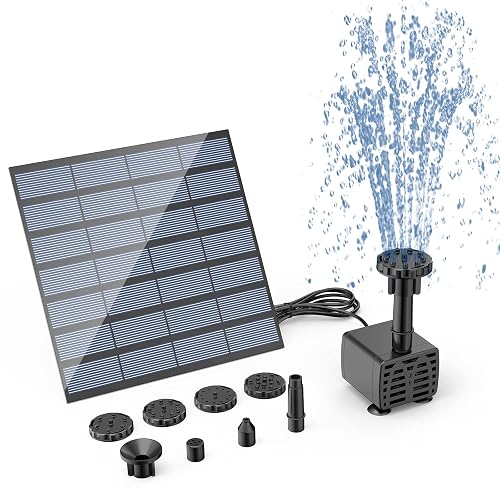
For a small garden pond or fountain, a compact DC submersible unit paired with a matching panel is a common starting point. Look for a pump whose published curve covers your head height at the flow you need. View on Amazon
If you want water stored for later use, a solar pump kit with battery backup keeps the flow going after sunset. View on Amazon
For deeper reading, see Solar Water Pumps Explained: How PV Pumping Systems Work and Fountain Pump Solar Powered: How to Size, Set Up and Maintain One. For a broader look at heating systems, How Does a Solar Water Heater Work? A Homeowner’s Explanation covers the thermal side.
FAQ
Does a solar water pump work on cloudy days?
It works at reduced output. Flow drops in proportion to the light reaching the panel, so cloudy conditions may slow or stop the pump entirely if the panel is too small for the motor.
Do I need a battery with a solar pump?
Not always. Direct-drive systems run only when the sun is up. A battery lets the pump operate after dark or on overcast days, but it adds cost and maintenance.
How do I know what size pump I need?
Measure your total head and the flow you need, then check the manufacturer’s performance curve. Consult a qualified installer or irrigation specialist for large or complex installations.
Related reading
- Solar Water Heater Pumps: How They Work and How to Size One
- Solar Water Heater Pumps and Controllers: How Active Systems Run
- Solar Water Heater Pressure Pump: How to Size and Set One Up
Ready to choose one?
About Ethan Brooks
Ethan Brooks is part of our editorial team and reviews and edits our solar water systems guides, checking product details against manufacturer specifications and owner feedback.