By Ethan Brooks
Updated November 2026
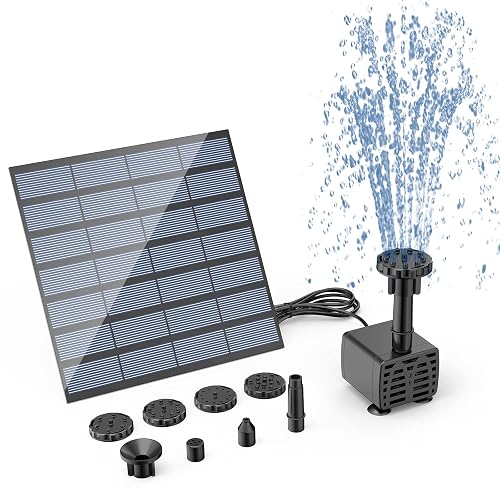
A solar water fountain pump works by converting sunlight into electricity with a small photovoltaic panel, which powers a DC motor that drives an impeller. The impeller pushes water up through a tube and out the nozzle. Output depends on how much sun reaches the panel and how high the water has to climb.
The Basic Sequence: Panel, Motor, Impeller
Most solar fountain pumps are small submersible units sitting in the basin. The panel sits above water, usually on a short stake or attached to the pump housing, and connects to the motor by a low-voltage cable. When light hits the cells, the panel produces DC current. That current spins the motor, the motor turns the impeller, and the impeller draws water in through the intake and forces it up the discharge tube. Nothing moves until the panel sees enough light to overcome the motor’s startup load.
Shopping for one? See our guide: 5 Best Solar Water Pumps for Small Fountain Picks Compared (2026).
What Controls the Flow You Actually Get
Flow rate, usually given in gallons per hour (GPH) or liters per hour, is set by three things working together. The first is panel output, measured in watts. A panel rated near the pump’s requirement will run it at full speed only in strong midday sun. The second is head height, the vertical distance from the water surface to the top of the fountain spout. Flow drops sharply as head rises, because the motor has to do more work against gravity. The third is friction loss in the tubing and nozzle. Narrow tubing and tight bends reduce flow even at the same height.
Manufacturers typically publish a maximum head, and owners often report that actual flow at the top of that range is far lower than the number on the box. Check the flow chart for your specific model rather than the headline figure.
Sizing and Setup Tips
- Measure head height from the water surface to the highest point of the spout, not the basin rim.
- Match the panel wattage to the pump’s rated input, and place the panel where it gets direct sun for most of the day, ideally six or more hours.
- Keep the panel clean. Dust and pollen can cut output noticeably on a sunny day.
- Use tubing at the diameter the pump specifies. Undersized tubing wastes power.
- Choose a nozzle that suits your flow. A very restrictive nozzle can stall a weak pump.
- If the fountain runs weakly only in the morning or evening, that is normal. Plan for it, or add a battery backup model.
What We’d Use
For a small garden fountain with a modest head height, a compact submersible kit with a matched panel keeps setup simple. View on Amazon
If you want water running after sunset, a model with a built-in battery reserve is worth considering. View on Amazon
FAQ
Does a solar fountain pump work on cloudy days?
It runs at reduced speed under cloud cover, and may stop entirely in heavy overcast. Flow generally tracks the light level.
Why is my solar fountain pump so weak?
The usual causes are excessive head height, a dirty panel, shaded placement, or tubing that is too narrow. Check each of these before assuming the pump is faulty.
Can I run a solar fountain pump at night?
Only if it has a battery backup. Without storage, the pump stops when the panel stops producing power. For electrical questions beyond basic setup, consult a qualified electrician.
Related reading
- Solar Water Pumps Explained: How PV Pumping Systems Work
- Solar Water Heater Pumps: How They Work and How to Size One
- Top 7 Solar Power Water Pumps for Fountain Picks Compared in 2026
- Submersible Solar Water Pump for Fountain: 5 Best Picks Compared (2026)
- Solar Water Pump Fountain Picks: 7 Best Options for 2026
Ready to choose one?
About Ethan Brooks
Ethan Brooks is part of our editorial team and reviews and edits our solar water systems guides, checking product details against manufacturer specifications and owner feedback.