 By Emily Parker
Updated November 2026
An off-grid desert water system has to do three things well: produce or move enough water for daily use, handle the mineral load and dust common in arid areas, and run without grid power. The picks below are ranked by fit against those criteria: daily output in gallons, filtration range, power independence, and how well each unit suits remote desert sites. Owners often report that the right match depends on whether they need drinking water, pumped well water, or both.
Best overall: Rover R.O. – View on Amazon
Best for hand-crank backup: Greeshow 0.01-Micron Portable Filter – View on Amazon
Best for gravity-fed households: ICEPURE 2.25G Gravity Filter – View on Amazon
Best for storage capacity: LifeStraw Peak Gravity Filter – View on Amazon
Best for solar-charged field use: ITEHIL Portable Electric Filter – View on Amazon
Best for seawater or brackish sources: Manual Water Desalination System – View on Amazon
Best for drinking-water RO at a fixed site: Countertop RO Filter System – View on Amazon
Our Top Picks
| Product | Best for | Key feature |
|---|---|---|
| Rover R.O. | Mobile off-grid RO output | 200 gallons per day |
| Greeshow Portable Water Filter | Hand-crank backup | 0.01-micron filtration |
| ICEPURE 2.25G Gravity Filter | Gravity-fed households | Stainless steel countertop |
| LifeStraw Peak Gravity Filter | Storage capacity | 8 L + 8 L tanks |
| ITEHIL Portable Electric Filter | Solar-charged field use | Built-in solar charging |
| Manual Water Desalination System | Seawater or brackish sources | 0.53 gal per hour |
| Countertop RO Filter System | Drinking-water RO at a fixed site | Instant hot water |
Rover R.O. | Off-Grid, Portable Reverse Osmosis Travel Water System

Rover R.O. | Off-Grid, Portable Reverse Osmosis Travel Water System (200 Gallons Per Day)
Best for: Mobile off-grid RO output
A fit for trucks, vans and trailers where the water source is variable and the user needs a steady supply of treated drinking water. Manufacturers specify about 200 gallons per day of output.
Pros
- High daily output for a portable unit
- Reverse osmosis removes dissolved salts
Cons
- Requires a pressure source and a reasonable feed-water supply
Greeshow 0.01-Micron Water Purification System, Solar/Hand-Crank/USB-C Rechargeable

0.01-Micron Water Purification System, Solar/Hand-Crank/USB-C Rechargeable, 3000mAh Power Bank & LED Light Greeshow Portable Electric Water Filter for Camping & Emergency
Best for: Hand-crank backup
Suited to users who want a filter that works without any fixed power source, including during extended desert travel. The 0.01-micron rating is listed for bacteria and protozoa.
Pros
- Multiple charging options including solar and hand-crank
- Compact enough to carry on day trips
Cons
- Lower throughput than gravity or RO systems
ICEPURE 2.25G Gravity-fed Water Filter System with Sight Glass Spigot
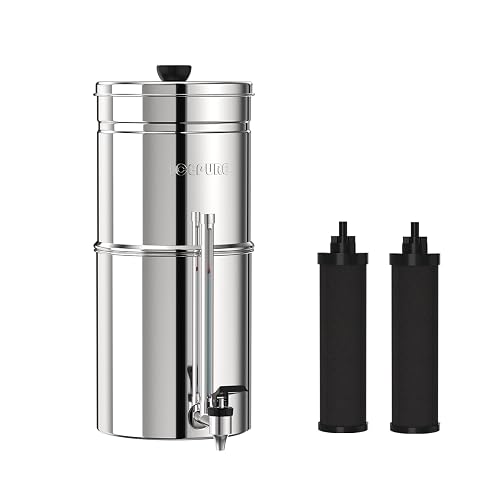
ICEPURE 2.25G Gravity-fed Water Filter System with Sight Glass Spigot, 304 Stainless Steel Countertop System, 2 Black Carbon Filters, Reduce 99% Chlorine, Lead for Home, Camping, Emergencies
Best for: Gravity-fed households
Works for a fixed camp or cabin where water is hauled and then filtered by gravity. Listings cite chlorine and lead reduction using carbon filters.
Pros
- No electricity or pump needed
- Stainless steel housing with a visible water-level sight glass
Cons
- Output depends on how often the reservoir is refilled
LifeStraw Peak Gravity Water Filter with Storage, 8 L, Mountain Blue

Large-Capacity Gravity Water Filter System with Storage, 8L + 8L, for Camping, RVing, Overlanding, and Travel LifeStraw Peak Gravity Water Filter with Storage, 8 L, Mountain Blue
Best for: Storage capacity
Best for groups that need a larger reserve between refills. The two-tank layout keeps raw and treated water separated.
Pros
- Large combined capacity of 8 L + 8 L
- Simple setup with no tools
Cons
- Bulky to transport compared with pocket filters
ITEHIL Portable Electric Water Filter, 0.01 Micron Camping Water Purifier with Solar

ITEHIL Portable Electric Water Filter, 0.01 Micron Camping Water Purifier with Solar, Outdoor Water Purification System for Camping, Hiking, Emergency & Survival
Best for: Solar-charged field use
A practical choice for users who want a pump-style filter that can be recharged from a small solar panel between trips. Top 5 Best Off Grid Water System Picks for Remote Living (2026) goes further into this.
Pros
- Built-in solar charging
- Fine 0.01-micron rating
Cons
- Battery capacity limits how much water you can treat per charge
Lightweight Compact Design; Off Grid Water Maker; Manual Water Desalination System

Lightweight Compact Design; Off Grid Water Maker; Backpacking Water Filtration System; Essential Sea Survival Gear Manual Water Desalination System,97% Desalination,Desalinator 0.53 gal/Hr
Best for: Seawater or brackish sources
Aimed at users with access to saline or brackish water and no electricity. Listings give a rate of about 0.53 gallons per hour.
Pros
- No power required
- Useful as an emergency desalination backup
Cons
- Slow output and manual effort per gallon
Buying Guide
Daily Water Output
Start by estimating how many gallons your household or site needs each day, including drinking, cooking, cleaning, and any livestock or garden use. Reverse osmosis units produce water more slowly than gravity or electric filters, so match the rated daily output to your real demand rather than your best-case scenario.
Gravity-fed systems hold a reserve in storage tanks, which helps cover peak usage between refills. Think about how often you can refill and whether you will be filtering from a tank, a well, or a container.
Filtration Range and Mineral Handling
Desert water often carries dissolved salts, hardness, dust, and sometimes arsenic or fluoride. Check whether the system is rated for the contaminants present in your source water, since a microfilter alone will not remove dissolved minerals. Reverse osmosis systems handle dissolved solids best, while membrane and carbon filters suit microbial and sediment concerns.
If you are unsure about your water quality, a local water test is the most reliable starting point before you choose a system.
Power Independence
An off-grid desert water system should run without relying on the grid. Look closely at what powers each unit. Hand-crank, solar-compatible, and USB-C rechargeable designs offer flexibility, while pump-driven reverse osmosis systems need a dependable battery or generator setup. Make sure your power plan matches the system’s draw.
Manual units require no electricity at all, which can be valuable as a backup during extended sun-limited periods.
Portability Versus Installation
Decide whether you need something you can carry to a campsite or a fixed unit that serves a permanent home or cabin. Portable systems are easier to relocate and store, but they usually produce less water per day. Countertop and under-sink installations offer higher throughput and convenience, but they depend on a stable setup and access to water pressure or a pump. For a deeper look, 6 Best Off Grid Van Water System Picks for 2026 covers this in detail.
FAQ
Can a portable filter remove salt from desert water?
Most portable microfilters and gravity filters remove bacteria, protozoa, and sediment but not dissolved salts. Reverse osmosis and desalination systems are the options that address dissolved minerals. Always check the rated contaminant list before buying.
How much water do I need per person in a desert setting?
Drinking needs vary with heat, activity, and body size, so desert households typically plan for more than the standard amount used in mild climates. Add extra for cooking, hygiene, and any animals or plants you maintain. Build in a margin so you are not short during hot spells.
Do I need solar panels to run an off-grid water system?
Not every system requires solar. Gravity and hand-crank units operate without any power source, while pump-based reverse osmosis systems need electricity from a battery, solar array, or generator. Pair your choice with a power plan that covers your daily draw.
How often do filter cartridges need replacement?
Replacement timing depends on water quality, daily volume, and the specific cartridge design. Dusty or high-sediment desert sources can shorten filter life, so monitor flow rate and taste. Keep spare cartridges on hand because remote sites may not have easy access to replacements.
Is a gravity filter enough for a full household?
Gravity filters can supply a household for drinking and cooking if you refill the storage reservoir regularly. They are less suited to large-volume uses like showers or irrigation. Many households pair a gravity system for drinking water with a separate source for other needs. You may also like Top 5 Off-Grid Solar Water System Picks for Remote Properties.
Conclusion
If you need high daily output and can support a pump with reliable power, the reverse osmosis options fit best for full remote households. For backup, emergencies, or lighter drinking needs, hand-crank, solar-compatible, and gravity-fed units offer simpler, power-free operation.
Match your pick to your daily gallons, your water source, and your power setup, and you will have a dependable off-grid desert water system that suits your site.
Related reading
- Youtube Off Grid Water System: A Step-by-Step Guide for Beginners
- Water System Off Grid: A Step-by-Step Guide to Planning Yours
- Top 7 Off Grid Water System from Creek Picks for Remote Properties
- Top 7 Off Grid Portable Reverse Osmosis Travel Water System Picks for 2026
- Top 5 Off-Grid Grey Water Filtration System Picks for Remote Homes
- Top 5 Off Grid Water Systems for Camper Picks for 2026
- Top 5 Off Grid Water System from Air Picks for Remote Homes
About Emily Parker
Emily Parker is part of our editorial team and reviews and edits our solar water systems guides, checking product details against manufacturer specifications and owner feedback.


