 By Ethan Brooks
Updated November 2026
Choosing an off-grid solar water system comes down to three numbers: how many gallons per day you need, how far the water has to be lifted (head height), and how much sun your site gets. This list compares seven products across those criteria, including portable purifiers, pumping kits, and solar power systems that run pumps and filters. Each pick is judged on flow rate, suitability for remote use, power requirements and how well the design fits a real water source.
Our top picks at a glance
- 1
 TOP CHOICEBest overallRover R.O. | Off-Grid, Portable Reverse Osmosis Travel Water SystemView on Amazon
- 2
 TOP CHOICEBest for whole-property powerECO-WORTHY 10KW Output Off Grid Solar System Complete KitView on Amazon
- 3
 TOP CHOICEBest for emergency filtrationGreeshow 0.01-Micron Water Purification SystemView on Amazon
- 4
 Best for camping kitsITEHIL Portable Electric Water FilterView on Amazon
- 5
 Best for DIY planningOff-Grid Power and Water Systems SimplifiedView on Amazon
- 6
 Best for wells and irrigation4 Solar Panels, Controller, Automatic Timer & Installation AccessoriesView on Amazon
- 7
 Best for larger loadsSUNGOLDPOWER 10000W Off Grid Solar system Complete Kit, 1*10KW 120V/24View on Amazon
Our Top Picks
Quick Comparison
| Product | Best for | Key feature |
|---|---|---|
| Rover R.O. Portable Reverse Osmosis System | Drinking water from any source | 200 gallons per day rating |
| ECO-WORTHY 10KW Off Grid Solar System Kit | Whole-property power | Split-phase 120V/240V output |
| Greeshow 0.01-Micron Water Purification System | Emergency filtration | Solar and hand-crank charging |
| ITEHIL Portable Electric Water Filter | Camping and hiking | 0.01-micron filtration |
| Off-Grid Power and Water Systems Simplified | DIY system planning | Solar and rainwater design guidance |
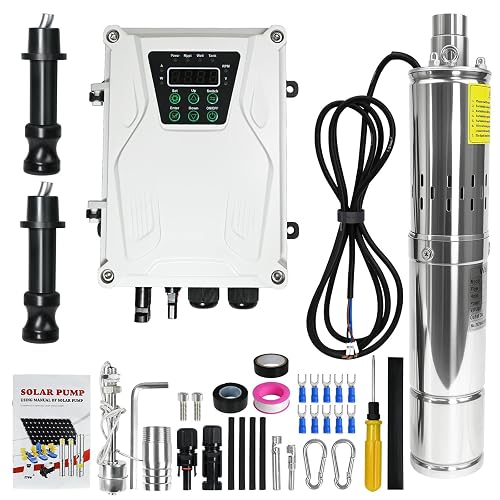
| 12V Submersible Deep Well Solar Water Pump Kit | Wells, irrigation and livestock | Four panels with controller and timer |
| SUNGOLDPOWER 10000W Off Grid Solar System Kit | Large household loads | 5 lithium batteries, 6.6 kW array |
Rover R.O. | Off-Grid, Portable Reverse Osmosis Travel Water System
Rover R.O. | Off-Grid, Portable Reverse Osmosis Travel Water System (200 Gallons Per Day)
Best for: Drinking water from any source
Suited to travelers, cabins and field work where you need potable water without a fixed plumbed system. Manufacturers specify a 200 gallon per day output rating, which is ample for a small household.
Pros
- Reverse osmosis removes a wide range of contaminants.
- Portable design needs no installation.
Cons
- Output depends on inlet pressure and water temperature.
ECO-WORTHY 10KW Output Off Grid Solar System Complete Kit
ECO-WORTHY 10KW Output Off Grid Solar System Complete Kit:10KW 120V/240V Output Split Phase Inverter| 4Pcs 48V 100Ah 20.48kWh High Capacity Energy Storage| 5310 Watts Solar Panel PV
Best for: Whole-property power
Designed for households that want to run a well pump, filtration and appliances from one solar installation. Listings specify 10 kW split-phase output and a 20.48 kWh battery bank.
Pros
- Split-phase output suits standard household wiring.
- Large battery capacity covers overnight pumping.
Cons
- Requires careful load calculation and professional wiring.
Greeshow 0.01-Micron Water Purification System
0.01-Micron Water Purification System, Solar/Hand-Crank/USB-C Rechargeable, 3000mAh Power Bank & LED Light Greeshow Portable Electric Water Filter for Camping & Emergency
Best for: Emergency filtration
Fits households that want backup drinking water during outages, with three charging options. Listings describe a 0.01-micron membrane and a built-in 3000mAh power bank.
Pros
- Works with solar, hand-crank or USB-C charging.
- Doubles as a power bank and LED light.
Cons
- Low hourly output compared with a pumped system.
ITEHIL Portable Electric Water Filter
ITEHIL Portable Electric Water Filter, 0.01 Micron Camping Water Purifier with Solar, Outdoor Water Purification System for Camping, Hiking, Emergency & Survival
Best for: Camping and hiking
Aimed at campers and hikers who want a lightweight purifier with optional solar charging. The 0.01-micron rating is specified in the listing.
Pros
- Compact and easy to carry.
- Solar charging extends trip length.
Cons
- Not sized for household daily volumes.
Off-Grid Power and Water Systems Simplified
Off-Grid Power and Water Systems Simplified: How to Harness Solar, Collect Rainwater, and Build Energy Independence with DIY Solutions
Best for: DIY system planning
A planning resource for readers who want to combine solar power with rainwater collection before buying hardware. It helps you map loads and sources first.
Pros
- Covers solar sizing and rainwater collection together.
Cons
- It is a guide, not equipment.
Buying Guide
Daily Water Volume Needed
Start by estimating how many gallons per day you actually need for drinking, cooking, washing, and any livestock or irrigation. Portable purifiers are built for personal or small-group use, while pumping kits and larger solar systems are better suited to households, farms, or ranches that move bigger volumes.
Water Source and Lift Height
A system that works well with a shallow surface source may struggle with a deep well or a long vertical lift. Check how far the water must travel and whether your source is a stream, rainwater tank, or well, since that determines whether you need a pump, a gravity filter, or a hand-operated option.
Consider the water quality you are dealing with as well. Membrane filters and reverse osmosis units handle a wider range of contaminants than basic pumps, so match the treatment stage to the likely problems in your source.
Solar Capacity and Energy Storage
Solar-powered pumps and filters need enough panel capacity and battery storage to run through cloudy days and nightfall. Look at the wattage of the panels, the storage capacity of the batteries, and whether the system can run on alternative charging such as hand-crank or USB-C if the sun is unreliable.
Portability Versus Permanent Installation
Decide whether you need something you can carry on a trip or a fixed installation that serves a property year-round. Portable units are simple to deploy but limited in output, while permanent kits require mounting, wiring, and more planning but deliver steadier supply for daily use.
Installation Effort and Maintenance
Consider how much setup work you are willing to do. Some kits include controllers, timers, and mounting hardware, while others are plug-and-go. Also plan for filter replacement, battery care, and periodic cleaning so the system keeps performing over time.
FAQ
How much water can an off-grid solar water system produce each day?
Output varies widely by product, from portable purifiers meant for personal use to pumping kits that can move larger volumes. The daily amount depends on sunlight, pump head height, and filter flow rate, so check the specifications for each model against your own needs.
Do I need batteries for a solar water system?
Batteries are useful if you want to pump or filter water when the sun is down or on overcast days. Some portable units can run directly from panels or be charged by hand-crank or USB-C, while larger systems rely on battery banks for continuous operation.
Can these systems make any water safe to drink?
Filtration and purification remove many contaminants, but no single system handles every water problem. Test your source if possible, and choose a product whose filter rating and treatment method match the kinds of contamination you expect.
What is the difference between a pumping kit and a purifier?
A pumping kit moves water from a source to where you need it, while a purifier cleans water that is already accessible. Many setups combine both, using a pump to lift water and a filter or purifier to make it safe for use. If you want more background, see Off Grid Solar Water Pump System: 6 Best Picks for Remote Properties in 2026.
How hard is it to install an off-grid solar water system?
Portable filters need little more than filling a bag or bottle, while solar pump kits and larger power systems require mounting panels, wiring components, and positioning the pump correctly. Basic electrical knowledge helps, and some homeowners prefer to hire an installer for the larger systems.
How often do the filters and batteries need replacing?
Replacement schedules depend on how much water passes through the filter and how the battery is used and stored. Follow the manufacturer’s maintenance guidance, and inspect filters and batteries regularly so the system keeps delivering safe water and reliable power.
Conclusion
If you need a light, portable option for camping, hiking, or emergencies, a compact electric or solar purifier is the most practical choice. For households, farms, or remote properties that need a steady daily supply, a solar pumping kit or a full off-grid power system paired with a purifier will serve you better.
Match your decision to your daily water volume, lift height, and available sun, and choose the level of installation effort you are comfortable with. Taking those three numbers into account will point you to the system that fits your property best.
Related reading
- 6 Best Eco-Worthy Solar Water Pump Kit Systems for Off-Grid Use (2026)
- 3 Best Solar Well Water Pump System Options for Off-Grid Use (2026)
- 3 Best Solar Panel Water Pump Systems for Off-Grid Use (2026)
- Youtube Off Grid Water System: A Step-by-Step Guide for Beginners
- Water System Off Grid: A Step-by-Step Guide to Planning Yours
About Ethan Brooks
Ethan Brooks is part of our editorial team and reviews and edits our solar water systems guides, checking product details against manufacturer specifications and owner feedback.