 By Ethan Brooks
Updated November 2026
Choosing a solar circulating water pump comes down to three numbers: flow rate in gallons per minute, maximum lift or head height in feet or meters, and the voltage your panel or controller supplies. This list compares seven DC pumps sold on Amazon US for solar hot water loops, heat-transfer circuits and small garden or bird bath setups. Each pick is judged on flow at realistic head, noise, temperature tolerance and whether it needs an external power adapter.
Our top picks at a glance
- 1
 TOP CHOICEBest overallLow Noise 3M Discharge Head 2.1GPM BYT-7A006 DC 12V Solar Hot Water HeView on Amazon
- 2
 TOP CHOICEBest for adapter-powered setupswith UL Listed DC Power Supply Adapter Low Noise 3M Head 8LPM 2.1GPM BView on Amazon
- 3
 TOP CHOICEBest for small bird baths2.5W Solar Water Pump, Anti-Clog Filter, Multiple Spray Nozzles, 2FT LView on Amazon
- 4
 Best for high-temperature loopsDC 12V Solar Water Heater Circulating Pump With DC Power Adapter, HighView on Amazon
- 5
 Best for higher lift14A DC 12V Water Pump Circulation Pump- 3.43GPM, 19.6ft Lift, Ultra-QuView on Amazon
- 6
 Best for electric backup loopsWater Circulator Pump 120W for Electric Water Heater System, StainlessView on Amazon
- 7
 Best for ponds and fountainsSolar Fountain – Panel Water Pump for Bird Bath Solar Panel Kit OutdooView on Amazon
Our Top Picks
Quick Comparison
| Product | Best for | Key feature |
|---|---|---|
| BYT-7A006 Circulation Pump | Solar hot water loops | 3M head, 2.1GPM |
| BYT-7A015 Circulation Pump | Adapter-powered systems | UL-listed DC adapter |
| 2.5W Solar Water Pump | Bird baths | Anti-clog filter, nozzles |
| DC 12V Circulating Pump | High-temperature loops | 4M lift, 2.64GPM |
| 14A DC 12V Circulation Pump | Higher lift runs | 19.6ft lift, brushless |
| 120W Water Circulator Pump | Electric backup loops | Stainless steel head |
| Solar Fountain Panel Pump | Ponds and fountains | Panel-powered kit |
Low Noise 3M Discharge Head 2.1GPM BYT-7A006 DC 12V Solar Hot Water Heater Circulation Pump
Low Noise 3M Discharge Head 2.1GPM BYT-7A006 DC 12V Solar Hot Water Heater Circulation Pump
Best for: Solar hot water loops with moderate head
Suited to homeowners running a closed solar thermal loop who need steady circulation at about 3 meters of lift without a loud motor.
Pros
- Rated 2.1 GPM at low head, matching typical small collector loops.
- Owners often describe it as quiet during daytime operation.
Cons
- Lift falls off quickly above its rated head.
with UL Listed DC Power Supply Adapter Low Noise 3M Head 8LPM 2.1GPM BYT-7A015 DC 12V Solar Hot Water Heater Circulation Pump
with UL Listed DC Power Supply Adapter Low Noise 3M Head 8LPM 2.1GPM BYT-7A015 DC 12V Solar Hot Water Heater Circulation Pump
Best for: Adapter-powered solar hot water circuits
A good fit if you want the pump supplied with a listed power adapter so you can run it from mains when panel output drops.
Pros
- Includes a UL-listed DC adapter, simplifying wiring.
- Same 3-meter head rating as the BYT-7A006.
Cons
- Adapter adds a plug-in point that needs a dry, protected location.
2.5W Solar Water Pump, Anti-Clog Filter, Multiple Spray Nozzles, 2FT Lift, No Battery Needed, for BirdBath, Small Pond Biling Solar Fountain for Bird Bath
2.5W Solar Water Pump, Anti-Clog Filter, Multiple Spray Nozzles, 2FT Lift, No Battery Needed, for BirdBath, Small Pond Biling Solar Fountain for Bird Bath, Dry-Run Protected Pump, 4FT Tubing
Best for: Small bird baths and shallow ponds
Aimed at garden owners who want a solar-only mover with spray nozzles for a bird bath or a few inches of standing water.
Pros
- Anti-clog filter and dry-run protection suit small basins.
- Only about 2 feet of lift, so setup stays simple.
Cons
- Flow is too low for any hot water loop.
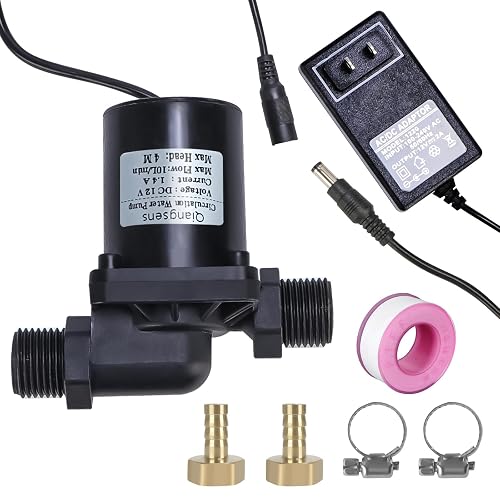
DC 12V Solar Water Heater Circulating Pump With DC Power Adapter, High-Temperature Resistant, Lift 4M, Flow Rate 10LPM 2.64GPM
DC 12V Solar Water Heater Circulating Pump With DC Power Adapter, High-Temperature Resistant, Lift 4M, Flow Rate 10LPM 2.64GPM
Best for: High-temperature solar loops
For systems where the fluid gets hot and head needs to reach about 4 meters, such as a rooftop tank feed.
Pros
- Listed flow of 10 LPM (2.64 GPM) at moderate lift.
- Manufacturer specifies high-temperature resistant construction.
Cons
- Check the temperature rating against your loop before installing.
14A DC 12V Water Pump Circulation Pump- 3.43GPM, 19.6ft Lift, Ultra-Quiet Brushless Motor w/Adapter
14A DC 12V Water Pump Circulation Pump- 3.43GPM, 19.6ft Lift, Ultra-Quiet Brushless Motor w/Adapter – for Solar Heaters, RVs, Brewing & Farms (Non-Self-Priming)
Best for: Higher-lift runs needing more flow
Useful when the water has to climb several feet or when you need a higher flow rate than the smaller pumps above.
Pros
- Listed 19.6 ft lift and 3.43 GPM flow.
- Brushless motor, which owners often report runs quietly.
Cons
- Non-self-priming, so it must be primed before startup.
Buying Guide
Flow Rate and Lift Height
Flow rate, listed in gallons per minute or liters per minute, tells you how much water the pump moves, but the number that matters most is the flow you actually get at your system’s lift height. A pump that moves plenty of water at zero head may slow down considerably once you push it up several feet, so check the lift rating and compare it to the vertical distance between your pump and the highest point of your loop.
Match the pump to your system size rather than buying the biggest option. Oversized pumps can waste energy and create unnecessary noise, while undersized ones may fail to circulate water evenly through a collector.
Voltage and Power Source
Most solar circulating pumps run on 12V DC, which pairs well with a small solar panel and battery or controller. Some models include a DC power adapter, which is useful if you plan to run the pump from a wall outlet or a backup supply, while others expect you to provide your own power source.
Confirm the voltage before you buy. Mismatched voltage is one of the most common causes of pumps that run weakly or fail early.
Temperature Tolerance
Solar hot water loops can get very hot, especially on sunny days when the collector stalls. Look for a pump rated for high-temperature water and check the maximum fluid temperature in the product details. Stainless steel heads and high-temperature-resistant seals generally hold up better than standard plastic components in these conditions.
Noise Level and Motor Design
If the pump sits near living space, noise matters. Brushless or ultra-quiet motors usually run more smoothly and produce less vibration than basic brushed designs. This is especially important for RV, brewing or residential installations where the pump runs for long periods.
Self-Priming and Dry-Run Protection
Some pumps are self-priming, meaning they can pull water up from a reservoir without being filled first. Others are non-self-priming and must be primed before startup. Dry-run protection shuts the pump off when water is absent, which helps prevent motor damage if the loop loses water. Choose based on how your system is plumbed and how likely it is to run dry.
FAQ
Can a solar circulating water pump run directly from a solar panel?
Some setups do run directly from a small panel, but many systems use a controller or battery to keep voltage steady. Direct operation works best when the panel’s output closely matches the pump’s rated voltage. Check the manufacturer’s recommendations before wiring the pump to a panel without a regulator.
How do I know what lift height I need?
Measure the vertical distance from the water source to the highest point the water must reach, then add a little extra margin. Pick a pump whose rated lift comfortably exceeds that number, since real-world flow drops as lift increases.
Do I need a power adapter with my pump?
It depends on your power source. If you plan to run the pump from a 12V DC supply or a solar controller, you may not need an adapter. If you want to plug it into a standard outlet, an adapter that converts AC to 12V DC will be required.
Are these pumps safe for potable water?
Check each product’s listed materials and intended use before using it with drinking water. Many are designed for hot water heating loops or ornamental water features rather than potable supply, so confirm the material ratings and certifications for your specific application.
How often should I clean or maintain the pump?
Inspect the pump and any filter or strainer at least a few times a year, or more often if your water carries debris or minerals. Clearing blockages keeps flow steady and reduces strain on the motor. Following the manufacturer’s cleaning steps will help the pump last longer.
Can I use a solar circulating pump for a bird bath or fountain?
Yes, smaller solar pumps designed for fountains and bird baths work well for decorative or garden water features. These models usually have lower lift and flow ratings, so they suit shallow setups better than hot water loops. Choose one with a filter if you want to reduce clogging from leaves and debris.
Conclusion
If you run a solar hot water loop with a moderate lift, choose a pump with a strong flow rating at your required head, a high-temperature-rated body and a quiet motor. Models that include a power adapter suit anyone who wants a plug-and-play setup, while non-adapter versions work well for existing solar controllers.
For garden ponds, bird baths and small fountains, a lighter solar pump with a filter and modest lift will do the job. Match the pump to your system’s actual flow and lift needs, and the right choice will be clear.
Related reading
- Why Is My Solar Heating Water Pump Not Circulating? 5 Causes and Fixes
- Solar Water Pumps Explained: How PV Pumping Systems Work
- Solar Water Heater Pumps and Controllers: How Active Systems Run
- Solar Water Heater Components: Collectors, Tanks, Pumps and Pipes
- Solar Pool Heating and Solar Water Pumps: An Overview
About Ethan Brooks
Ethan Brooks is part of our editorial team and reviews and edits our solar water systems guides, checking product details against manufacturer specifications and owner feedback.