By Ethan Brooks
Updated November 2026
Solar pool heater sizing is mostly a matter of matching collector area to your pool’s surface area, then adjusting for climate, how many hours of sun you get, and how long you want to swim. A common rule of thumb is that solar collector area should equal roughly 50 to 100 percent of the pool’s surface area, with the lower end suited to mild climates and the higher end for cool regions or early-season swimming. Getting this ratio right matters more than any single brand choice.
Why sizing matters more than most buyers expect
An undersized system will run constantly and still barely move the water temperature, which wears out pumps and wastes energy. An oversized system can overheat water on sunny afternoons and push your filter and plumbing harder than they were designed for. Either mistake shows up as disappointment: a pool that never feels warm, or one that is uncomfortably hot in July while your pump runs for hours to deliver it.
Shopping for one? See our guide: 8 Best Solar Water Pool Heater Options for Every Pool Size in 2026.
Solar heating is also slow by nature. Panels add heat gradually over the day, so the sizing decision determines how many degrees you can realistically gain in a 24-hour cycle. Think of collector area as the rate of heating, and pool volume as the bucket you are filling.
The factors that drive the calculation
Four variables do most of the work when you size a system.
- Pool surface area. Measure length times width for rectangular pools, or use the average of two diameters for round pools. Surface area, not volume, is the main driver because heat is lost and gained through the water’s surface.
- Climate and sun exposure. A pool in Arizona needs far less collector area than one in Oregon. Check average monthly solar radiation for your location and how many hours of unshaded sun your roof or ground mount receives.
- Desired temperature rise and season. Heating from 70°F to 80°F in spring is a different job than maintaining 84°F through a cool summer night. Decide which months you want to swim and by how many degrees.
- Wind and cover use. Wind strips heat quickly from an uncovered pool. A solar pool cover can cut evaporative losses substantially and often reduces the collector area you need.
How to estimate the number of panels
Start with the pool’s surface area, then apply a sizing ratio based on your climate. Warm, sunny regions with a pool cover may need collector area near half the pool’s surface. Cooler or windier sites, or owners who want an extended swimming season, often land near or above the full surface area.
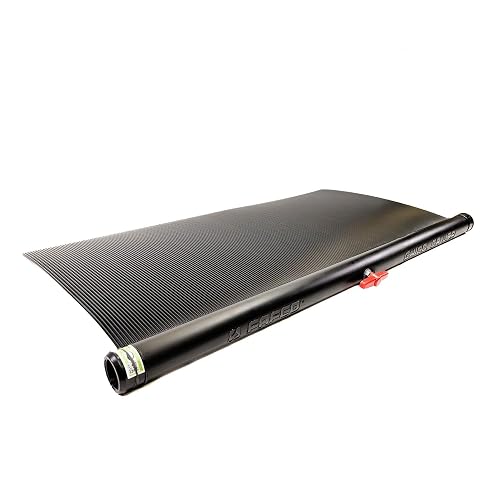
Next, convert collector area into panel count. Solar pool collectors are typically sold as unglazed polymer panels, and manufacturers specify the square footage of each panel. Divide your target collector area by the area of one panel and round up. Always confirm the panel dimensions in the spec sheet for the exact model you are considering, since sizes vary between manufacturers.
Finally, check the flow rate. Your pump needs to move enough water through the collectors to carry heat without starving them. Many installers aim for a flow that keeps the collectors evenly warmed, and manufacturers usually list a recommended flow range per panel or per system. A pump sized only for filtration may not deliver enough flow for a large collector array, which is a common reason systems underperform.
What to do about it
- Measure your pool’s surface area accurately, including any shallow steps or spa attachments you plan to heat.
- Note how many hours of direct sun reach your intended collector location, ideally during the months you plan to swim.
- Decide on a realistic temperature goal and which season matters most to you.
- Choose a starting ratio based on climate, then calculate collector area and divide by panel area to get a panel count.
- Check that your pump’s flow rate and head height suit the number of panels and the roof or ground layout.
- Plan for a bypass or diverter valve so you can shut the system off on hot days and prevent overheating.
- Consult a qualified installer or your pool equipment dealer before purchasing, especially if your roof structure or plumbing is unusual.
Common sizing mistakes
- Sizing from pool volume instead of surface area.
- Ignoring shade from trees or buildings that cut midday output.
- Forgetting that a pool cover can change the math significantly.
- Pairing a large collector array with a pump that cannot push enough flow.
- Assuming a larger system always heats faster in every season.
What we’d use
For a shortlist of commonly sold unglazed polymer collectors that match standard above-ground and in-ground pool sizes, look for a sized kit that lists its collector area and recommended flow clearly. A reliable choice is the Xtremepowerus Solar Pool Heater, which many buyers use as a starting point for sizing discussions. If your pool sits in a cooler climate and you want more heat, a larger collector kit from a major pool equipment brand paired with a dedicated pump is a practical upgrade.
Related questions
How many solar panels do I need for an above-ground pool?
Most above-ground pools fall in the range of half to full surface area in collector space, depending on climate. Measure your pool, apply a climate-based ratio, and divide by the panel size listed by the manufacturer.
Does a solar pool cover reduce how big my heater needs to be?
Yes. A cover limits evaporation and heat loss overnight and in windy conditions, which can lower the collector area you need. Many owners find the cover and the heater work together more efficiently than either does alone.
Can a solar pool heater be too big?
It can. An oversized array may overheat the pool on warm days, and it can strain the pump and filter. A bypass valve or thermostat control helps manage this.
Why does my solar pool heater not warm the pool enough?
The usual causes are undersized collectors, insufficient flow from the pump, shade on the panels, or a pool that loses heat quickly to wind or lack of cover. Recheck flow and surface area first.
Do I need a professional to size a solar pool heater?
Many owners size their own systems using manufacturer guidelines, but a pool professional can verify your calculations, especially for roof-mounted installations or complex plumbing. Consult a qualified installer when in doubt.
Related reading
- Xtremepowerus Solar Pool Heater: Setup, Sizing and Common Mistakes
- Solar Pool Heater Sizing Calculator: How Many Panels Do You Need?
- Solar Pool Heater Dome: How It Works, Sizing and Setup Steps
- Solar Hot Water Pool Heater: Sizing, Setup and Common Mistakes
- What Is a Solar Pool Heater Vacuum Breaker and Why Does It Matter?
Ready to choose one?
About Ethan Brooks
Ethan Brooks is part of our editorial team and reviews and edits our solar water systems guides, checking product details against manufacturer specifications and owner feedback.