 By Ethan Brooks
Updated November 2026
A solar powered water pump for house use can supply household taps, a storage tank, or a backup line without relying on the grid, but only if the pump’s flow rate and lift height match your water demand. This list compares seven DC pumps sold on Amazon US, grouped by the needs they fit best. Selection criteria: rated flow in gallons per minute (GPM), maximum head or lift in feet, voltage compatibility with common solar array sizes, and the controller type included. Product listings and owner feedback patterns were used for research; none of these pumps were tested by us.
Best overall: Solar Water Pump, 48V 500W DC Submersible Deep Well Pump – View on Amazon
Our Top Picks
Quick Comparison
| Product | Best for | Key feature |
|---|---|---|
| Solar Water Pump, 48V 500W DC Submersible Deep Well Pump | Deep well household supply | MPPT controller, 3-inch stainless body |
| Solar Pool Pump Kit, 0.7 HP 66 GPM 46 FT 48V DC | High-flow circulation | 66 GPM rated flow |
| 10W Solar Water Pump KIT with 18V 10W Panel | Small ponds and fountains | Brushless motor, 186 GPH |
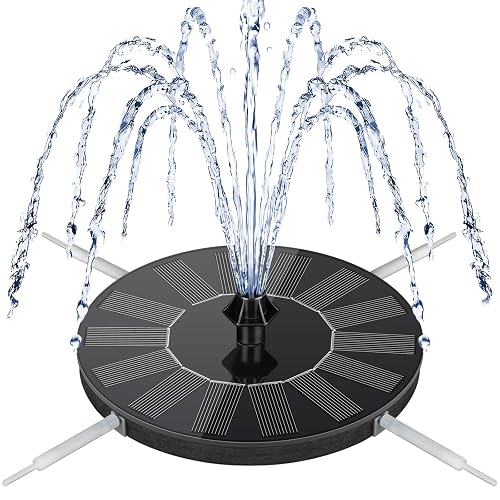
| 15W Solar Fountain Pump with 4 Nozzles | Birdbaths and garden features | Adjustable flow, anti-clog bag |
| BACOENG DC 12V Farm & Ranch Solar Water Pump | Shallow well and livestock | 26 ft lift |
| Solar DC Pump, 200W 3200RPM Self Priming | Shallow well household transfer | 25 m head, 35 LPM flow |
| 750W 48V DC Self-Priming Pool Pump with MPPT | Variable-speed circulation | Variable speed, MPPT controller |
Solar Water Pump, 48V 500W DC Submersible Deep Well Pump

Solar Water Pump, 48V 500W DC Submersible Deep Well Pump, 3 inch Stainless Steel Deep Well Pump with MPPT Controller for Industrial Irrigation Household Water Tank Water Supply
Best for: Deep well household supply with a storage tank.
This suits homeowners with a well deeper than a few meters who want a dedicated 48V system with a built-in MPPT controller to maximize output from the array.
Pros
- Stainless steel body rated for submersible use
- MPPT controller improves output in variable sun
Cons
- Requires a sizable panel array to reach full output
Solar Pool Pump Kit, 0.7 HP 66 GPM 46 FT 48V DC

Panel Guide: 650 W + | Voc<120V, solar power water pump Solar Pool Pump Kit,0.7 HP 66 GPM 46 FT 48 V DC, Pool Water Pump
Best for: High-flow circulation and pool-style water movement.
This fits owners who need strong flow over moderate lift, such as circulating a tank or pool, rather than lifting water from a deep well.
Pros
- 66 GPM rated flow is high for a solar DC pump
- Kit format simplifies matching panels
Cons
- Lift rating is lower than deep well models
10W Solar Water Pump KIT with 18V 10W Solar Panel

10W Solar Water Pump KIT: DC Brushless Submersible Water Pump 186 GpH with 18V 10W Solar Panel for Solar Fountain, Fish Pond, and Aquarium (No Backup Battery)
Best for: Small ponds, fountains, and aquariums.
This is a low-output kit for small water features, not whole-house supply. It is useful as a low-cost entry point to solar pumping.
Pros
- Complete kit with matched 10W panel
- Brushless motor for quieter running
Cons
- Flow of about 186 GPH is too small for household use
15W Solar Fountain Pump, 190GPH with 4 Nozzles

15W Solar Fountain Pump, 190GPH Submersible Solar Powered Water Pump with Adjustable Flow & 4 Nozzles, Anti-Clog Barrier Bag for Bird Bath, Outdoor Pond, Garden Water Features, Pool
Best for: Birdbaths and garden water features.
Owners with decorative water features will value the adjustable flow and nozzle set, though it cannot supply a house.
Pros
- Adjustable flow with four nozzles
- Anti-clog barrier bag protects the intake
Cons
- Not suitable for pumping to a house tank
BACOENG DC 12V Farm & Ranch Solar Water Pump

BACOENG DC 12V Farm & Ranch Solar Water Pump Submersible Well Pump 26ft Lift
Best for: Shallow well and livestock supply.
A 12V submersible option with 26 ft of lift suits rural properties with a modest water table and smaller array budgets.
Pros
- 12V system works with small battery-based setups
- 26 ft lift covers many shallow wells
Cons
- Lift limit rules out deeper wells
Solar DC Pump, 200W 3200RPM Self Priming, 25 m High

Solar DC Pump, 200W 3200RPM Large 25m High Self Priming Pump 35LPM Large Flow for Household Agricultural Irrigation Shallow Well Jet Irrigation Transfer (DC12V)
Best for: Shallow well household transfer.
Homeowners pulling from a shallow well or transferring water between tanks may prefer the self-priming design and 25 m head rating.
Pros
- Self-priming design simplifies shallow well setup
- 35 LPM flow is solid for household use
Cons
- Listing details vary, so confirm specs with the seller
750W 48V DC Self-Priming Pool Pump with MPPT Controller

750W 48V DC Self-Priming Pool Pump with MPPT Controller, Variable Speed High Flow Pool Circulation Pump, Spa & Water Features Solar Swimming Pool Pump
Best for: Variable-speed circulation and spa or water features.
Owners wanting to match flow to changing sunlight will appreciate the variable speed and MPPT control, though it is aimed at pool and spa use.
Pros
- Variable speed matches output to sunlight
- MPPT controller included
Cons
- Designed for pool circulation rather than household supply
Buying Guide
Match Flow Rate to Your Household Demand
Start by estimating how many gallons per minute your home actually needs at peak use, such as running a shower and a washing machine at the same time. A pump rated in GPM will only deliver that flow at the lift height listed on its performance curve, so check the figure at your real head height rather than the best-case number on the box.
Check Maximum Lift and Well Depth
Measure the vertical distance from the water source to the highest outlet in your home, and add a margin for friction loss in the pipe. Choose a pump whose maximum head in feet comfortably exceeds that total, since pumps run less efficiently when pushed close to their limit.
Confirm Voltage and Solar Array Compatibility
DC pumps are typically rated at 12V, 18V, or 48V, and the solar panel or array must be sized to match. Higher-voltage systems generally handle longer runs and higher lift more efficiently, so make sure your panel wattage and open-circuit voltage fall within the pump’s acceptable input range.
Decide Whether You Need an MPPT Controller
A maximum power point tracking (MPPT) controller adjusts the electrical load to get more output from the panels across changing sunlight, which helps on cloudy days and in the early morning. Pumps without a controller may still work well for simple setups, but MPPT is worth prioritizing for a whole-house system that relies on solar alone.
FAQ
Can a solar powered water pump supply my whole house?
Some higher-capacity DC pumps can supply a household tank or pressure system, but whole-house coverage depends on your daily water use, well depth, and available sunlight. Many homeowners pair a solar pump with a storage tank so water is available even when the sun is not shining.
Do solar water pumps work at night or on cloudy days?
Solar pumps only run when the panels produce enough power, so output drops or stops at night and during heavy cloud cover. Battery backup or a water storage tank is the usual way to cover those periods.
How many solar panels do I need for a house water pump?
The number depends on the pump’s power rating, its voltage, and how many hours of usable sunlight your location gets. Check the manufacturer’s recommended panel wattage and make sure the open-circuit voltage stays below the controller’s maximum input.
Is a deep well solar pump different from a pool or fountain pump?
Yes. Deep well and submersible pumps are built to lift water from greater depths and supply household pressure, while pool and fountain pumps are designed mainly for circulation and lower head heights. Using a pool or fountain pump for a home water supply will usually fall short on lift and flow.
Do I need a permit to install a solar water pump at home?
Requirements vary by city, county, and well type, so check with your local building or health department before installing a well-connected system. Some jurisdictions have rules for well construction, backflow prevention, and water testing.
Conclusion
For a deep well or whole-house supply, the higher-lift submersible and self-priming DC models are the better fit, provided your panel setup matches their voltage. For garden, pond, or fountain use, the smaller 10W and 15W kits and the 12V farm pump cover lighter, lower-lift tasks more economically.
Households that want the most flexibility should prioritize a pump with an MPPT controller and enough head for their well depth, then size storage to bridge cloudy periods. Pool-focused circulation pumps suit spa and pool owners, not primary water supply.
Related reading
- Why Does My Solar Powered Hot Water Pump Stop Working? Causes and Fixes
- Top 5 Solar Powered Water Pumps for Cattle Options Compared (2026)
- Top 4 Solar Powered Water Pumps with Timer Options Compared for Gardens
- Solar Powered Water Well Pump Systems: A Step-by-Step Guide (2026)
- Solar Powered Water Pump for Small Fountain: 7 Best Picks Compared (2026)
- Solar Powered Water Pump for Irrigation: 6 Best Picks Compared (2026)
- Solar Powered Water Pump Waterfall: Step-by-Step Setup for 2026
About Ethan Brooks
Ethan Brooks is part of our editorial team and reviews and edits our solar water systems guides, checking product details against manufacturer specifications and owner feedback.