By Ethan Brooks
Updated November 2026
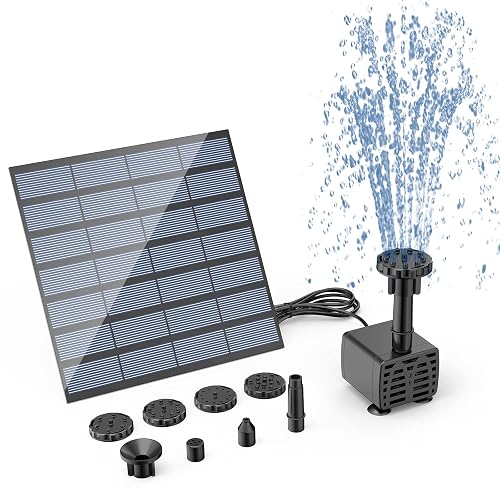
A solar powered water pump waterfall moves water from a basin or pond up to a higher point and lets it fall back down, all without a grid connection. To get it right, you need three numbers: the flow rate you want at the top, the head height the pump must lift against, and the panel wattage that can deliver both. This guide walks through each one so you can choose a pump and panel that match your waterfall.
Step 1: Decide on the flow rate you want
Flow rate is the volume of water the pump moves per hour, usually given in gallons per hour (GPH) or liters per hour (LPH). A narrow, gentle trickle may need only 100 to 200 GPH, while a wider sheet of falling water often needs 400 GPH or more. Flow rate sets the visual look, but it also drives everything else, so settle on it first.
Shopping for one? See our guide: Solar Powered Water Pump for Small Fountain: 7 Best Picks Compared (2026).
Step 2: Measure the total head height
Head height is the vertical distance from the water surface in the basin to the highest point where water leaves the spillway or tubing. Measure it straight up, not along the slope. Then add friction loss from the tubing. Longer runs, narrow hoses and sharp bends all add resistance, and the pump has to overcome it. As a rough rule, add a few feet of equivalent head for every 10 feet of tubing, more if the tubing is small in diameter.
Step 3: Match the pump curve to your numbers
Every submersible pump publishes a performance curve or table showing flow at different heads. Find your flow rate at your total head height, not at zero head. A pump rated for 500 GPH at zero head may deliver only 150 GPH at 6 feet of lift. Pick a model whose curve passes through your target point with some margin.
Quick sizing checklist
- Write down the target flow rate in GPH.
- Measure vertical lift and add friction loss from the tubing.
- Check the manufacturer’s head-versus-flow table for that combination.
- Confirm the outlet fitting or tubing size matches the pump.
- Choose a panel rated at or above the pump’s input wattage, with extra for cloudy days.
Step 4: Size the solar panel and battery
Pump wattage is the power the pump draws while running. Most small solar fountain pumps run on panels in the 10 to 50 watt range, but pumps with higher head or flow need more. Pick a panel whose rated output is at least the pump’s maximum draw. Direct sun gives the best output, so place the panel where it gets full sun for most of the day, and angle it toward the equator. Owners often report that a shaded panel can cut output sharply, so check for overhanging branches or nearby structures.
If you want the waterfall to run after dark or on overcast days, look for a model with battery backup. Batteries add complexity, so confirm the battery chemistry and charge controller are compatible with the pump before buying.
Common mistakes
- Sizing the pump by its maximum flow instead of the flow at your actual head height.
- Using tubing that is too narrow, which cuts flow and can overheat the pump.
- Placing the panel in partial shade and wondering why the waterfall slows in the afternoon.
- Letting the basin run low, so the pump draws air and loses prime. Keep the intake submerged at all times.
- Forgetting to clean the intake screen, which is the most common cause of reduced flow.
Recommended gear
- Submersible solar fountain pump with a head-flow chart: A pump whose published table covers your head height lets you confirm flow before you buy. View on Amazon
- Solar panel kit sized for the pump: A matched panel and pump pair removes guesswork about voltage compatibility. View on Amazon
- Flexible tubing and fittings: Keeping the tubing diameter at or above the pump outlet reduces friction loss. View on Amazon
FAQ
How high can a solar powered water pump waterfall lift water?
Lift depends on the specific pump. Check the manufacturer’s head rating, and remember that flow drops as head rises, so a pump rated for 6 feet may deliver very little at that height.
Do I need a battery for a solar waterfall?
A battery is only needed if you want the waterfall to run at night or through cloudy spells. Without one, the pump runs only while the panel produces enough power, which is often fine for daytime display.
Can I use a larger panel than the pump needs?
Yes, a larger panel generally helps the pump start and run steadily in lower light, as long as the controller and pump voltage are compatible. Consult the pump manufacturer or a qualified installer if you are unsure about electrical matching.
Conclusion
A solar powered water pump waterfall works best when the flow rate, head height and panel wattage are matched before you buy. Measure your lift, add friction loss, and read the pump’s head-flow table to confirm real output. With those numbers in hand, you can set up a cascade that looks good and runs reliably in full sun.
Related reading
- Why Does My Solar Powered Hot Water Pump Stop Working? Causes and Fixes
- Solar Powered Water Well Pump Systems: A Step-by-Step Guide (2026)
- Solar Powered Water Pump Rain Barrel Setup: A Step-by-Step Guide
Ready to choose one?
About Ethan Brooks
Ethan Brooks is part of our editorial team and reviews and edits our solar water systems guides, checking product details against manufacturer specifications and owner feedback.