By Miles Fisher
A solar pool heater sizing calculator estimates how much collector area you need by starting with your pool’s surface area, then adjusting for climate, the temperature rise you want and how many hours of sun you get. As a rough working rule, many pool owners plan for solar collector area equal to 50 to 100 percent of the pool surface, with the lower end suited to mild climates and the higher end to cool ones or to heating for extended swim seasons.
Why a Sizing Calculator Matters More Than Guesswork
Undersized collectors leave the pool cold and the system running every day with little payback. Oversized collectors cost more to install, add flow resistance to the pump and can overheat the water in summer if there is no bypass or controller to manage them. A sizing calculator gives you a defensible starting point so you can talk to an installer with real numbers instead of accepting whatever area they propose.
Shopping for one? See our guide: 6 Best Starlite SLC Solar Collectors (2026): Expert Picks.
Solar pool heating is also a flow problem as much as a heat problem. Collectors work only when the pump moves enough water through them, and the head loss across the panels determines whether the pump you already have can keep up. Sizing the collector without checking flow and head is how systems end up heating very little.
The Main Factors a Calculator Uses
Most sizing methods, whether a spreadsheet or a manufacturer’s chart, weigh the same inputs:
- Pool surface area. Measure length times width for rectangular pools, or use the average of the two diameters for round ones. Surface area drives heat loss, so it is the starting number.
- Climate and solar irradiance. A pool in a sunny desert region needs less collector area than one in a cloudy northern location. Local average daily solar energy values, often listed in kilowatt-hours per square meter per day, are the usual input.
- Desired temperature rise. Heating from 60°F to 80°F takes less collector area than heating from 50°F to 84°F. Decide the temperature you want and the months you want it.
- Wind exposure and cover use. Windy sites lose heat faster. A solid pool cover used overnight cuts heat loss substantially, which lets you size lower.
- Pump flow rate. Collectors perform best at a specific flow per square foot of panel. Compare the flow your pump delivers at the system’s total head against the collector manufacturer’s recommended range.
Working Through a Sizing Estimate
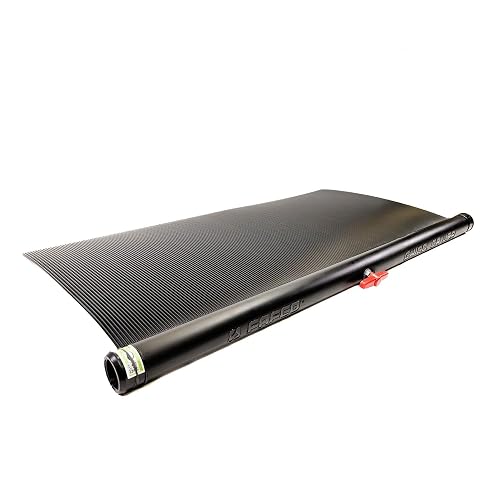
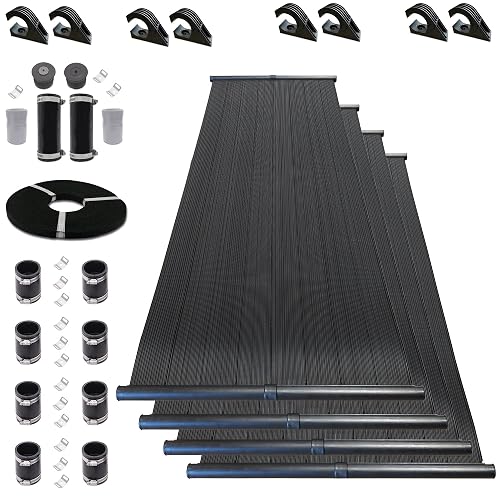
Here is a simplified example to show the logic. Suppose you have a 16 by 32 foot pool, which is 512 square feet of surface. A pool in a moderately sunny climate, used from late spring into early fall, and covered at night, might reasonably target collector area near 60 percent of pool surface. That puts the collector area around 300 square feet. If the collector you are considering is 4 feet by 10 feet, or 40 square feet per panel, you would plan about eight panels. Treat this as a planning figure only. A proper calculation uses your local solar data and the collector’s rated performance curve.
Notice what changes the answer. Remove the cover and wind exposure rises, so the same pool may need closer to the upper end of the range. Extend the season into cool shoulder months and you may need more area than a summer-only plan. Those tradeoffs are the reason to run the numbers for your own site.
What to Do With the Result
- Measure the pool carefully and record surface area in square feet.
- Pick a target temperature and the months you intend to use the pool.
- Find your local average solar energy and note how many sunny hours you get in your swim season.
- Calculate a target collector area using the percentage approach or the manufacturer’s sizing table.
- Divide by the area of one collector to get the panel count, rounding up if you plan to add a cover later.
- Check that your pump can deliver the recommended flow through the collector array at its total head, including filter and plumbing losses.
- Confirm the layout fits your roof or ground space and that it drains properly for freeze protection where needed.
If your pump is marginal, adding collectors can make things worse by increasing head loss. In that case a larger pump or a smaller array with a better-matched flow is the sounder fix. Our overview of Solar Pool Heating: How It Works and What to Plan covers how the pump, collectors and controls fit together, and Solar Pool Heating and Solar Water Pumps: An Overview explains pump selection in more detail.
Related questions
Can I size a solar pool heater from pool volume instead of surface area?
Surface area is the better basis because heat loss happens at the water surface. Volume matters mainly for estimating how much water must be heated and for turnover and filtration.
Does a pool cover really change the collector count?
Yes. A solid cover used overnight reduces evaporative and radiant losses, which can justify a smaller collector array for the same season.
Should I oversize the collectors to be safe?
Modest oversizing is common, but large oversizing wastes money and can add flow restriction. Pair any extra area with a bypass or controller so the water does not overheat in peak summer.
Where can I find local solar data for the calculation?
Government and university solar resource maps list average daily solar energy by location. Use the value for your nearest station and the months you plan to heat.
Do I need a professional to finalize the sizing?
For a basic estimate, the steps above are enough. For final design, including roof loading, plumbing and freeze protection, consult a licensed installer or a qualified solar contractor.
Related reading
- Sizing a Solar Water Heater for Your Household’s Hot Water Demand
- Where Solar Water Heating Is Used: Homes, Pools and Beyond
- What Affects Solar Water Heater Efficiency and Performance
- Solar Water Heater Troubleshooting: Common Problems and Causes
Ready to choose one?

About Miles Fisher
Miles focuses on practical advice for solar water systems: what matters before you buy, what to skip, and how to get more out of what you already own.