 By Ethan Brooks
Updated November 2026
A solar water pump aquaponics system moves water from your fish tank up to the grow beds and back down again, using energy from the sun instead of the grid. Done right, the pump delivers enough flow to keep your plant roots wet and your fish water oxygenated, around the clock on sunny days. This guide walks through how to size the pump, match it to your panel, and set it up so the loop runs reliably.
Start With Flow Rate and Head Height
Two numbers drive every aquaponics pump decision: the flow rate you need and the total head height the pump must lift water against. Flow is usually expressed in gallons per hour (GPH) or liters per hour (LPH). Head height is the vertical distance from the water surface in the sump to the highest point of the grow bed, plus friction loss from the tubing.
Shopping for one? See our guide: 5 Best Solar Water Pumps for Small Fountain Picks Compared (2026).
A common rule for media beds is to turn over the entire grow bed volume roughly every 5 to 15 minutes, though many growers aim near the lower end for deep water culture and the higher end for gravel beds. Measure your grow bed volume in gallons, divide by the cycle time in minutes, then multiply by 60 to get GPH. Add a margin of 20 to 30 percent for tubing friction and loss in fittings.
Match the Pump to Your Solar Panel
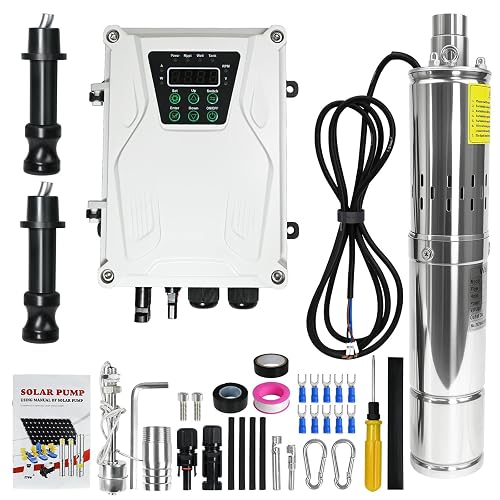
Solar pumps are rated at specific voltage and wattage, and they perform best when the panel delivers close to their rated input. Manufacturers typically specify a maximum head and flow curve for each model. Choose a pump whose curve at your actual head height still gives you the GPH you calculated, not just the best-case number on the box.
Next, check that the panel’s peak output meets the pump’s input requirement. Many small aquaponics systems use a DC submersible pump paired with a single panel and a direct-drive or basic controller. Because output drops on cloudy days, owners often report that pumps run at reduced flow in the morning and late afternoon. Accept that, or add a second panel or battery backup if steady flow matters for your fish.
Set Up the Loop Safely
- Place the sump or fish tank at the lowest point, and position the pump submerged in the sump with a strainer over the intake.
- Run the outlet tubing up to the grow bed’s inlet, keeping the vertical run as short as practical to reduce head.
- Add a valve or flow restrictor to fine-tune output, and a check valve if you want to prevent backflow when the pump stops.
- Route the return from the grow bed back to the sump by gravity, sized so the bed drains fully without overflowing.
- Test the system with clean water for 24 hours before adding fish, watching for leaks, air pockets and pump noise.
Common Mistakes
- Sizing the pump to the flat-water rating and ignoring head height losses.
- Letting the pump run dry, which can burn out the motor quickly. Keep the intake submerged at all times.
- Skipping a strainer, so debris and fish waste clog the impeller.
- Using undersized tubing, which adds friction and cuts flow more than most people expect.
- Forgetting that solar output varies, so plan for reduced flow during low-light periods.
Recommended Gear
- Submersible DC pump: A small DC pump rated for your calculated GPH lets you run directly off a panel without a complex controller. View on Amazon
- Inline flow valve: A simple ball valve on the outlet lets you dial in flow after installation without changing the pump. View on Amazon
- Pump strainer or intake screen: Keeps gravel, leaves and fish waste away from the impeller. View on Amazon
FAQ
How much flow does a small aquaponics bed need?
Most grow beds work well when the full volume turns over every 5 to 15 minutes. Calculate bed volume in gallons, divide by the cycle time, and convert to GPH.
Can a solar pump run an aquaponics system all day?
It can run during daylight, but flow drops with cloud cover and it stops at night. Add battery storage or accept intermittent flow if you need continuous circulation.
Should I consult a professional before wiring a solar pump?
For simple DC pump-and-panel setups, most hobbyists can manage the connections. If you plan a larger system with batteries or mains backup, consult a licensed electrician or a qualified solar installer.
Conclusion
A well-sized solar water pump keeps aquaponics water moving through your beds and back to the fish without constant attention. Start with GPH and head height, match the pump curve and panel output to those numbers, and test the loop before adding livestock. Build in a margin for losses, and your system will hold up through seasonal changes in sunlight.
Related reading
- Why Is My Solar Heating Water Pump Not Circulating? 5 Causes and Fixes
- Why Does My Solar Powered Hot Water Pump Stop Working? Causes and Fixes
- Why Does My Pump for Solar Hot Water Keep Shutting Off? Causes and Fixes
Ready to choose one?
About Ethan Brooks
Ethan Brooks is part of our editorial team and reviews and edits our solar water systems guides, checking product details against manufacturer specifications and owner feedback.